#>   subject time1 time2 death creatinine
#> 1   Smith     0    90     0        0.9
#> 2   Smith    90   120     0        1.5
#> 3   Smith   120   185     0        1.2
#> 4   Jones     0    52     0        1.3
#> 5 Jones 52 90 1 1.8Using Time Dependent Covariates and Time Dependent Coefficients in the Cox Model
1 Introduction
This vignette covers 3 different but interrelated concepts:
- An introduction to time-dependent covariates, along with some of the most common mistakes.
- Tools for creating time-dependent covariates, or rather the datasets used to encode them.
- Time-dependent coefficients.
Suppose that we want to model a medical process over time, the progression of a chronic liver disease for instance, and that the patients in the study have multiple visits over the time period with several covariates measured at each visit. It is straightforward to write down a prediction model that uses patient information at enrollment. One of the stengths of the Cox proportional hazard model is that it can (properly) also use the values that are updated over time, something known as time-dependent covariates. If I am being seen by my physician I would like him/her to use the most recent values, after all, not just those at inception of disease.
One of the common forms to represent this evolving data is to use a counting process data set. Consider a subject with follow-up from time 0 to death at 185 days, and assume that we have a time dependent covariate (creatinine) that was measured at day 0, 90 and 120 with values of .9, 1.5, and 1.2 mg/dl. The data for two subjects might look like the following
We read this as stating that over the interval from 0 to 90 the creatinine for subject Smith is taken to be 0.9 (last known level), and that this interval did not end in a death. In fact, Smith was still alive at their last contact on day 185, while Jones died on day 90. The underlying code treats intervals as open on the left and closed on the right, e.g. Smith’s creatinine on exactly day 90 is 0.9; This is the value used when computing the Cox partial likelihood term associated with Jone’s death on day 90.
2 Time dependent covariates and immortal time bias
2.1 Background
One of the strengths of the Cox model is its ability to encompass covariates that change over time. The practical reason is the form of the Cox parial likelihood, which has a term for each death (or event) time. \[ PL = \prod_{i \in D} \frac{e^{X_i(t_i) \beta}} {\sum_j Y_j(t_i) e^{X_j(t_i)\beta}} \] In the above \(D\) is the set of events, \(t_i\) is the time of the \(i\)th event (which occured for subject \(i\)), \(\beta\) the vector of coefficients, \(X_j(t)\) the covariates for subject \(j\) at time \(t\), and \(Y_j(t)\) a 0/1 indicator that subject \(j\) was at risk (under observation) at time \(t\).
One can think of it as a lottery model, where at each death time there is a drawing to decide which subject wins'' the event. Each subject's risk score $\exp(X\beta)$ determines how likely they are to win, e.g., how manytickets’’ they have purchased for the drawing. The model tries to assign a risk score to each subject that best predicts the outcome of each drawing based on
- The risk set: which subjects are present for each event; the set of those able to ``win the prize’’.
- The covariate values of each subject just prior to the event time.
The model has a theoretical foundation in counting process theory and martingales, mathematical constructs which arose out of the study of games of chance. Key elements of that notation are
- \(Y_i(t)\): whether subject \(i\) is at risk for an event, at time \(t\)
- \(N_i(t)\): the cumulative count of events for subject \(i\)
- \(X_i(t)\): predictive covariats for subject \(i\), at time \(t\)
A key underlying condition for valid inference on a counting process is that none of \(Y\), \(N\) or \(X\) depend on the future, or more formally that each is a predictable process. actions depend only on the past. The decision of whether to play If this holds then multiple properties can be proven about the resulting process, including the statistical aspects important to us. The key rule for time dependent covariates in a Cox model is essentially the same as that for gambling: you cannot look into the future. The size of the wager (\(X(t)\)) or the decision on whether to participate in a given spin of the roulette wheel may may change in any way based on past data or outcomes, but it may not reach forward in time.
We refer to the violation of this rule, for any of \(X\), \(Y\) or \(N\) as immortal time bias (ITB), though the term has most often been associate with violations of the covariates \(X\). There are myriad ways to break this rule, and we will only list a few of the more common ones below as illustration. The results of ITB can range from a large negative bias to a large positive one and anything in between, the common outcome is that you can’t trust the results.
2.2 Analysis by treatment response
One of the more common manifestations of this error is analysis by response. At the end of a trial a survival curve is made comparing those who had an early response to treatment (shrinkage of tumor, lowering of cholesterol, or whatever) to those who did not, and it discovered that responders have a better curve. A Cox model fit to the same data will demonstrate a strong “significant” effect. The problem arises because any early deaths, those that occur before response can be assessed, will all be assigned to the non-responder group, even deaths that have nothing to do with the condition under study. Below is a simple example based on the advanced lung cancer data set. Assume that subjects came in monthly for a total of 12 cycles of treatment, and randomly declare a “response” for 5% of the subjects at each visit. Below is a curve showing the results from a random simulation using follow-up time and survival from the lung study.
set.seed(1953)  # a good year
nvisit <- floor(pmin(lung$time/30.5, 12))
response <- rbinom(nrow(lung), nvisit, .05) > 0
badfit <- survfit(Surv(time/365.25, status) ~ response, data=lung)
plot(badfit, mark.time=FALSE, lty=1:2,
     xlab="Years post diagnosis", ylab="Survival")
legend(1.5, .85, c("Responders", "Non-responders"),
       lty=2:1, bty='n')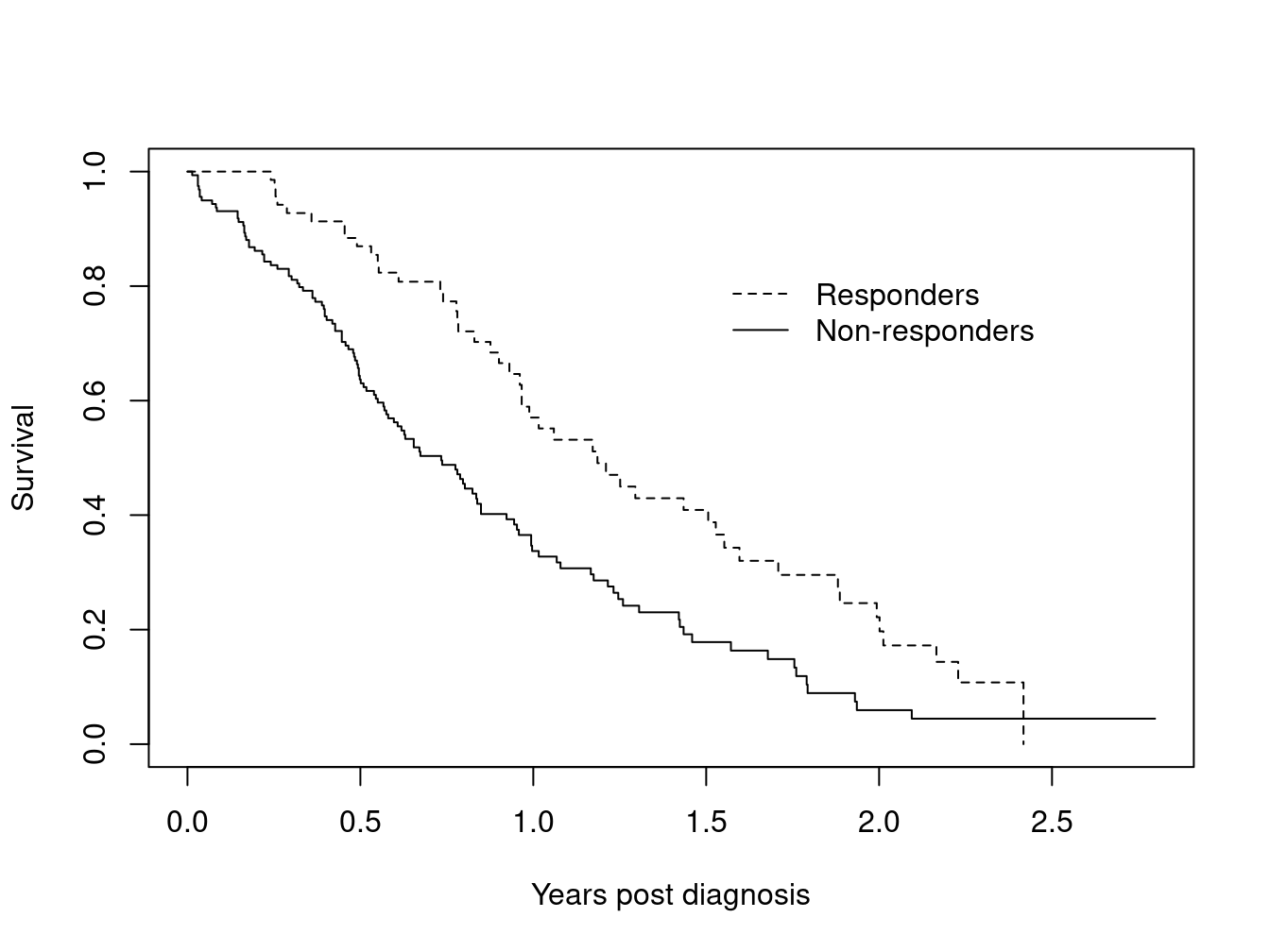
What is most surprising about this error is the size of the false effect that is produced. A Cox model using the above data reports a hazard ratio of 1.9 fold with a p-value of less than 1 in 1000.
The alarm about this incorrect approach has been sounded often (1983; 1996; 2008) but the analysis is routinely re-discovered.
2.3 Analysis by dose
A slightly subtler form of the error is discussed in Redmond et al. (1983). The exploration was motivated by a flawed analysis presented in Bonadonna et al. (1981) in a top medical journal. When treating breast cancer, chemotherapy dosages are reduced for patients who have severe toxicity, e.g., too low a white blood cell count, and the question being asked was whether these reductions have a negative impact on response and/or survival. To that end breast cancer chemotherapy patients were divided into three groups based on whether the patient eventually received \(>85\)%, 65–85% or \(<65\)% of the dose planned at the start of their treatment. Since early deaths do not finish all their cycles of chemotherapy and hence by definition finish with lower fraction, the result is guarranteed. Early death which predicts a low total dose, and not vice-versa. A proportional hazards model using total dose received showed a very strong effect for dose, so much so that it could encourage a treating physician to defer necessary dose reductions in response to treatment toxicity. This false result actively harmed patients.
Redmond also looked at a further variant of this: create a variable \(p\) for each subject which is the fraction of the the target dose, received up to the last entry for that subject. A subject who died after receiving only 6 weeks of a planned 12 week regimen could still score 100%. This looks like it should cure the bias issue, but it turns out to give bias in the other direction. The reason is that dose reductions due to toxicity occur more often in the later cycles of treatment, and thus living longer leads to smaller values of \(p\). A proportional hazards regression fit to \(p\) implies that a smaller dose is protective! The proper approach is to code the predictor as a time-dependent covariate, using a (time1, time2) counting process data set, with cumulative dose to date, either total or the fraction expected to date, as the covariate.
2.4 Interpolated values
Say that a liver disease subject has 5 visits at 0, 1, 4 years, with bilirubin values of .9, 1.1, NA, 2.5, and 3, i.e.; the value at visit 3 is missing. A common impulse is to replace the missing value with the linear interpolation of 1.8, but this is again a case of ITB since it make use of future data; the value of 2.5 has not yet been seen. A variant of this would be multiple imputation that used all covariates at all times. What is valid would be to extrapolate as .9, 1.1, 1.3. A good way to think of this is to imagine filling in the missing value on the day it arose, using all the information available at that time.
2.5 Cases versus controls
A fairly common report in early studies of a condition is to compare all those subjects who failed within 3 years to those who survived at least 3 years without failure, labeled as “cases” and “controls” (replace 3 with some value appropriate to the condition). The problem are those who joined the study or acquired the condition 2 years ago: severe cases who failed within a year will get counted as a case, those who are still alive at 2 years are not counted in either group. The result is both an overestimate of the probability of death within 3 years and biased estimates of effect: the earliest deaths, which presumably have the most extreme predictor values, are over-represented. A variant of this with regard to cancer death rates was commented on over 75 years ago Berkson and Gage (1950).
2.6 Future vs future tabulation
In a recent analysis from the Mayo Clinic study of aging (MCSA), the primary interest is the future risks of mild cognitive impairment (MCI), dementia, and death. The paper starts out with a table comparing baseline covariates for those who never progress to MCI versus those who ever did, and likewise baseline covariates versus death. there is also a table of baseline covariates versus survival. Both of these are fine: if you think in terms of an R formula they could be written with future outcome on the left hand side of the formula and current information on the right.
A table that compared the survival of those who did or did not progress to MCI, however, would be invalid. It corresponds to a model with a future occurrence on both sides of the equation. Nevertheless, the table 1 of many research papers contain such a comparison.
2.7 Summary
There are many further variations on this error: removing subjects who do not finish the treatment plan, imputing the date of an adverse event as midway between observation times, requiring two sequential visits with high blood sugar to declare diabetes but then assigned the date of diabetes to the earlier of the two, . Using future data will often generate large positive or negative bias in the coefficients, but sometimes it generates little bias at all. It is nearly impossible to predict a priori which of these will occur in any given data set. Using such a covariate is similar to crossing a freeway on foot: disaster is not guaranteed — but it is likely.
3 Creating data sets
The survival package can accommodate three forms of input: simple, “counting process” and “timeline” data sets. For simple survival the data has one line per subject containing their covariates, time to event, and a status code for censored or dead. The latter is normally 0/1 or FALSE/TRUE for censored/event, respectively. (As a footnote, 1/2 for censored/event is still allowed, a historical artifact dating back to the earliest data sets the authors used. In the 1960s and early 1970s much of the data used by the Mayo Clinic Section of Biostatistics was still on punch cards, and a FORTRAN program reading numeric data from punch cards did not distinguish 0 from blank. Hence ‘0’ was never used as a code, a convention and habit that outlived the use of cards.)
3.1 Counting process form
The counting process form has was added to the package in 1986, as a way to deal with time dependent covariates. For example the data set mydata might have the form
| subject | time1 | time2 | status | age | creatinine | … |
|---|---|---|---|---|---|---|
| 1 | 0 | 15 | 0 | 25 | 1.3 | |
| 1 | 15 | 46 | 0 | 25 | 1.5 | |
| 1 | 46 | 73 | 0 | 25 | 1.4 | |
| 1 | 73 | 100 | 1 | 25 | 1.6 |
In this case the variable age = age at entry to the study stays the same from line to line, while the value of creatinine varies and is treated as 1.3 over the interval \((0, 15]\), 1.5 over \((15, 46]\), etc. The intervals are open on the left and closed on the right, which means that the creatinine is taken to be 1.3 on day 15. The status variable describes whether or not each interval ends in an event, and will by definition be 0 for all rows of a subject except the last.
Only later did we realize that this form was useful in other ways. Avital Cnaan pointed out fairly early a use for time-dependent strata. She had a data set where the outcome was the use of particular social services, with the analysis stratified by county, as they had different policies. Some subjects had moved partway through. A bit later we realized that the form could be used for repeated events, i.e., the Andersen-Gill model; the only change is that now some subjects will have multiple rows with a status of 1. Multistate models are the most recent passenger, and a bit more complex.
One common question with this data setup is whether we need to worry about correlated data, since a given subject has multiple observations. The answer is no, we do not. The reason is that this representation is simply a programming trick. The likelihood equations at any time point use only one copy of any subject, the program picks out the correct row of data at each time. There is on exception to this rule, i.e., when a subject appears in overlapping intervals. This however is almost always a data error, since it corresponds to two copies of the
3.2 Building time-dependent sets with tmerge
A useful function for building data sets is tmerge, which is part of the survival library. The idea is to build up a time dependent data set one endpoint at a time. The primary arguments are
- data1: the base data set that will be added onto
- data2: the source for new information
- id: the subject identifier in both data1 and data2
- \(\ldots\): additional arguments that add variables to the data set
- tstart, tstop: used to set the time range for each subject
- options
The created data set has three new variables (at least), which are id, tstart and tstop.
The key part of the call are the “\(\ldots\)” arguments which each can be one of four types: tdc() and cumtdc() add a time dependent variable, event() and cumevent() add a new endpoint. Time intervals are treated as open on the left and closed on the right, i.e., (tstart, tstop]. Time dependent covariates apply from the start of an interval and events occur at the end of an interval. If a data set already had intervals of (0,10] and (10, 14] a new time dependent covariate or event at time 8 would lead to three intervals of (0,8], (8,10], and (10,14]; the new time-dependent covariate value would be added to the second interval, a new event would be added to the first one.
The basic form of the function is
newdata <- tmerge(data1, data2, id, newvar=tdc(time, value), ...)Where data1 is the starting dataset and additions to the data are taken from data2. The idea behind the function is that each addition will be “slipped in” to the original data in the same way that one would add a new folder into a file cabinet. It is a complex function, and we illustrate it below with a set of examples that sequentially reveal its features.
3.2.1 CGD dataset
Chronic granulomatous disease (CGD) is a heterogeneous group of uncommon inherited disorders characterized by recurrent pyogenic infections that usually begin early in life and may lead to death in childhood. In 1986, Genentech, Inc. conducted a randomized, double-blind, placebo-controlled trial in 128 CGD patients who received Genentech’s humanized interferon gamma (rIFN-g) or placebo three times daily for a year. Data were collected on all serious infections until the end of followup, which occurred before day 400 for most patients. One patient was taken off on the day of his last infection; all others have some followup after their last episode.
Below are the first 10 observations, see the help page for cgd0 for the full list of variable names. The last few columns contain the duration of follow-up for the subject followed by infection times. Subject 1 was followed for 414 days and had infections on days 219 and 373, subject 2 had 7 infections and subject 3 had none.
  1 204 082888 1 2 12 147.0  62.0 2 2 2 2 414 219 373
  2 204 082888 0 1 15 159.0  47.5 2 2 1 2 439   8  26 152 241 249 322 350
  3 204 082988 1 1 19 171.0  72.7 1 2 1 2 382
  4 204 091388 1 1 12 142.0  34.0 1 2 1 2 388
  5 238 092888 0 1 17 162.5  52.7 1 2 1 1 383 246 253
  6 245 093088 1 2 44 153.3  45.0 2 2 2 2 364
  7 245 093088 0 1 22 175.0  59.7 1 2 1 2 364 292
  8 245 093088 1 1  7 111.0  17.4 1 2 1 2 363
  9 238 100488 0 1 27 176.0  82.8 2 2 1 1 349 294
 10 238 100488 1 1  5 113.0  19.5 1 2 1 1 371
The dataset is included as cgd0 in the survival library. Here is the R printout of the first four subjects.
cgd0[1:4,]
#>   id center random treat sex age height weight inherit steroids
#> 1  1    204  82888     1   2  12    147   62.0       2        2
#> 2  2    204  82888     0   1  15    159   47.5       2        2
#> 3  3    204  82988     1   1  19    171   72.7       1        2
#> 4  4    204  91388     1   1  12    142   34.0       1        2
#>   propylac hos.cat futime etime1 etime2 etime3 etime4 etime5 etime6
#> 1        2       2    414    219    373     NA     NA     NA     NA
#> 2        1       2    439      8     26    152    241    249    322
#> 3        1       2    382     NA     NA     NA     NA     NA     NA
#> 4        1       2    388     NA     NA     NA     NA     NA     NA
#>   etime7
#> 1     NA
#> 2    350
#> 3     NA
#> 4     NA
We want to turn this into a dataset that has survival in a counting process form.
- Each row of the resulting dataset represents a time interval (time1, time2] which is open on the left and closed on the right. Covariate values for each row are the covariate values that apply over that interval.
- The event variable for each row \(i\) is 1 if the time interval ends with an event and 0 otherwise.
We don’t need variables etime1–etime7 in the final dataset, so they are left out of the data1 argument in the first call.
dim(cgd0)
#> [1] 128  20
newcgd <- tmerge(data1=cgd0[, 1:13], data2=cgd0, id=id, tstop=futime)
newcgd <- tmerge(newcgd, cgd0, id=id, infect = event(etime1))
newcgd <- tmerge(newcgd, cgd0, id=id, infect = event(etime2))
newcgd <- tmerge(newcgd, cgd0, id=id, infect = event(etime3))
newcgd <- tmerge(newcgd, cgd0, id=id, infect = event(etime4))
newcgd <- tmerge(newcgd, cgd0, id=id, infect = event(etime5))
newcgd <- tmerge(newcgd, cgd0, id=id, infect = event(etime6))
newcgd <- tmerge(newcgd, cgd0, id=id, infect = event(etime7))
newcgd <- tmerge(newcgd, newcgd, id, enum=cumtdc(tstart))
dim(newcgd)
#> [1] 203  17
newcgd[1:5,c(1, 4:6, 13:17)]
#>   id treat sex age futime tstart tstop infect enum
#> 1  1     1   2  12    414      0   219      1    1
#> 2  1     1   2  12    414    219   373      1    2
#> 3  1     1   2  12    414    373   414      0    3
#> 4  2     0   1  15    439      0     8      1    1
#> 5  2     0   1  15    439      8    26      1    2
summary(newcgd)
#> Call:
#> tmerge(data1 = newcgd, data2 = newcgd, id = id, enum = cumtdc(tstart))
#>
#>        early late gap within boundary leading trailing tied missid
#> infect     0    0   0     44        0       0        0    0      0
#> infect     0    0   0     16        0       0        1    0      0
#> infect     0    0   0      8        0       0        0    0      0
#> infect     0    0   0      3        0       0        0    0      0
#> infect     0    0   0      2        0       0        0    0      0
#> infect     0    0   0      1        0       0        0    0      0
#> infect     0    0   0      1        0       0        0    0      0
#> enum       0    0   0      0       75     128        0    0      0
coxph(Surv(tstart, tstop, infect) ~ treat + inherit + steroids,
      data =newcgd, cluster = id)
#> Call:
#> coxph(formula = Surv(tstart, tstop, infect) ~ treat + inherit +
#>     steroids, data = newcgd, cluster = id)
#>
#>             coef exp(coef) se(coef) robust se      z        p
#> treat    -1.0722    0.3422   0.2619    0.3118 -3.438 0.000585
#> inherit   0.1777    1.1944   0.2356    0.3180  0.559 0.576395
#> steroids -0.7726    0.4618   0.5169    0.4687 -1.648 0.099310
#>
#> Likelihood ratio test=22.49  on 3 df, p=5.149e-05
#> n= 203, number of events= 76
These lines show the canonical way to use tmerge: each call adds one more bit of information to the dataset.
- The first call sets the time range for each subject to be from 0 (default) to last follow-up. If a later call tried to add an event outside that range, at time = -2 say, that addition would be ignored. The range can be set explicitly by using the tstop and (optional) tstart arguments, or implicitly as will be done in the heart transplant example below. This first result has 128 rows, the same number as
cgd0. - Each additional call then adds either an endpoint or a covariate, splitting individual rows of the input into two as necessary. An
eventorcumeventdirective adds events, while atdcorcumtdccommand adds a time-dependent covariate. Events happen at the ends of intervals and time-dependent covariates change at the start of an interval.
- Additions from
data2with a missing time value are ignored. - The result of
tmergeis a data frame with a few extra attributes. One of these, tcount, is designed to help visualize the process, it is printed out by the summary function. Assume that a subject already had 3 intervals of (2,5), (5,10) and (14,40). A new event added at time 1 would be “early” while one at time 50 is after any interval and would be recorded as “late”. An event at time 3 is within an interval, one at 5 is on the border of two intervals, one at 14 is at the leading edge of an interval, one at time 10 in on the trailing edge, and one at time 11 is in a gap. In this dataset all new additions fell strictly within prior intervals. We also see that etime6 and etime7 each added only a single event to the data. Only one subject had more than 5 infections. - If two observations in data2 for a single person share exactly the same time, the created value will be the later contribution for
tdc()orevent()calls,cumtdc()andcumevent()will add. The “tied” column tells how often this happened; in some datasets this behavior might not be desired and one would need to break the ties before calling tmerge. - If there are observations in
data2that do not match any of the identifiers indata1they count in the `missid’ column. - The last tmerge call adds a simple time-dependent variable
enumwhich is a running observation count for each subject. This can often be a useful variable in later models or processing, e.g.enum==1selects off the first row for each subject. - The extra attributes of the data frame are ephemeral: they will be lost as soon as any further manipulation is done. This is intentional. The reason is that these may be invalid if, for instance, a subset of the data was selected.
- One can verify that the resulting dataset is equivalent to
cgd, a (start, stop] version of the CGD data in the survival library, which had been created by hand several years earlier.
The tmerge function processes arguments sequentially, and the above example can be rewritten as below. There is no computational advantage of one form versus the other.
test  <- tmerge(cgd0[, 1:13], cgd0, id=id, tstop=futime,
                 infect = event(etime1), infect= event(etime2),
                 infect = event(etime3), infect= event(etime4),
                 infect = event(etime5), infect= event(etime6),
                 infect = event(etime7))
test <- tmerge(test, test,  id= id, enum = cumtdc(tstart))
all.equal(newcgd, test)
#> [1] "Attributes: < Component \"call\": target, current do not match when deparsed >"
This example is atypical in that we have used a wide dataset, one with multiple outcomes per subject on a single line. The tmerge function was primarily designed to work with long data. An underlying issue is that when you create a new variable with tmerge from multiple source variables, and those variables are not of exactly the same structure, then tmerge can become confused. If etime1 was numeric and etime2 had a difftime class for example. If issues arise create a long form dataset and merge that in, as shown below. Both the data.table and tidyr libraries have well regarded functions to do this; below we use the reshape function from base R.
# create a long dataset with the recurrences
temp <- reshape(cgd0[c(1, 14:20)], varying= 2:8, v.names="etime",
                 idvar="id", direction="long")
cgdrecur <- subset(temp, !is.na(etime))  # toss missings (not essential)

newcgd <- tmerge(data1=cgd0[, 1:13], data2=cgd0, id=id, tstop=futime)
newcgd <- tmerge(newcgd, cgdrecur, id=id, infect= event(etime))
3.2.2 Stanford heart transplant
The jasa dataset contains information from the Stanford heart transplant study, in the form that it appeared in the J American Statistical Association paper of Crowley and Hu (1977). The dataset has one line per subject which contains the baseline covariates along with dates of enrollment, transplant, and death or last follow-up. We want to create transplant as a time-dependent covariate. As is often the case with real data, this dataset contains a few anomalies that need to be dealt with when setting up an analysis dataset.
One subject died on the day of entry. However (0,0) is an illegal time interval for the
coxphroutine.
It suffices to have them die on day 0.5. An alternative is to add 1 day to everyone’s follow-up, e.g., subject 2 who enrolled on Jan 2 1968 and died on Jan 7 would be credited with 6 days. (This is what Kalbfleisch and Prentice do in their textbook.) The result of the finalcoxphcall is the same from either strategy.A subject transplanted on day 10 is considered to have been on medical treatment for days 1–10 and as transplanted starting on day 11. That is, except for patient 38 who died on the same day as their procedure. They should be treated as a transplant death; the problem is resolved by moving this forward in time by .5 day.
The treatment coefficients in table 6.1 of the definitive analysis found in Kalbfleisch and Prentice (2002) will only be obtained if covariates are defined in precisely the same way, since their models include interactions. (Table 5.2 in the original edition of the book). For age this is (age in days)/ 365.25 - 48 years, and for year of enrollment it is the number of years since the start of the study: (entry date - 1967/10/1)/365.25. (Until I figured this out I would get occasional “why is coxph giving the wrong answers” emails.)
Since time is in days the fractional time of 0.5 could be any value between 0 and 1, our choice will not affect the results.
jasa$subject <- 1:nrow(jasa)  #we need an identifier variable
tdata <- with(jasa, data.frame(subject = subject,
                               futime= pmax(.5, fu.date - accept.dt),
                               txtime= ifelse(tx.date== fu.date,
                                              (tx.date -accept.dt) -.5,
                                              (tx.date - accept.dt)),
                               fustat = fustat
                             ))
xdata <- tmerge(jasa, tdata, id=subject,
                  death = event(futime, fustat),
                  transplant   =  tdc(txtime),
                  options= list(idname="subject"))

sdata <- tmerge(jasa, tdata, id=subject,
                  death = event(futime, fustat),
                  trt   =  tdc(txtime),
                  options= list(idname="subject"))
summary(sdata)
#> Call:
#> tmerge(data1 = jasa, data2 = tdata, id = subject, death = event(futime,
#>     fustat), trt = tdc(txtime), options = list(idname = "subject"))
#>
#>       early late gap within boundary leading trailing tied missid
#> death     0    0   0      0        0       0      103    0      0
#> trt       0    0   0     67        0       2        0    0      0
sdata$age <- sdata$age -48
sdata$year <- as.numeric(sdata$accept.dt - as.Date("1967-10-01"))/365.25

# model 6 of the table in K&P
coxph(Surv(tstart, tstop, death) ~ age*trt + surgery + year,
      data= sdata, ties="breslow")
#> Call:
#> coxph(formula = Surv(tstart, tstop, death) ~ age * trt + surgery +
#>     year, data = sdata, ties = "breslow")
#>
#>             coef exp(coef) se(coef)      z      p
#> age      0.01527   1.01539  0.01750  0.873 0.3828
#> trt      0.04457   1.04558  0.32171  0.139 0.8898
#> surgery -0.62113   0.53734  0.36786 -1.688 0.0913
#> year    -0.13608   0.87278  0.07090 -1.919 0.0550
#> age:trt  0.02703   1.02740  0.02714  0.996 0.3193
#>
#> Likelihood ratio test=16.06  on 5 df, p=0.006687
#> n= 170, number of events= 75
This example shows a special case for the tmerge function that is quite common: if the first created variable is an event then the time range for each subject is inferred to be from 0 to that event time: explicit tstop and tstart arguments are not required. It also makes use of a two argument form of event. Each of the event and cumevent functions may have a second argument, which if present will be used as the value for the event code. If this second argument is not present a value of 1 is used. If an event variable is already a part of data1, then our updates make changes to that variable, possibly adding more events. This feature is what allowed for the infection indicator to be build up incrementally in the cgd example above.
The tdc and cumtdc arguments can have 1, 2 or three arguments. The first is always the time point, the second, if present, is the value to be inserted, and an optional third argument is the initial value. If the tdc call has a single argument the result is always a 0/1 variable, 0 before the time point and 1 after. For the 2 or three argument form, the starting value before the first definition of the new variable (before the first time point) will be the initial value. The default for the initial value is NA, the value of the tdcstart option. If the tdc variable being created is already a part of data1, the old value is replaced wholesale, it is not updated. This differs from the behavior for events. Although there is a use case for updating an existing time-dependent value, say from a new data source, our experience had been that the much more common case was accidental reuse of an existing name, resulting in a chimeric mishmash between an existing baseline covariate and the additions, and creating a column which was valid for neither. Equally, some examples showed that we can not reliably update a tdc, i.e., cases where the correct answer is unclear.
The tcount table for the above fit shows all the deaths at the trailing edge of their interval, which is expected since the time of death or last follow-up was used to define each subject’s interval of risk. Two of the transplants happened on day 0 and are listed as occurring on the leading edge of the first follow-up interval for the subject. The other 67 transplants were strictly within the (0, last follow up) interval of each subject.
The tcount summary table has the following columns:
- early: occurs prior to the start of the subject’s timeframe.
- late: occurs after the end of a subjects timeframe.
- gap: occurs in a gap between intervals at risk. If someone is at risk of the event from day 0 to 30, and then from day 50 to day 70. A count would occur under
gap, if the covariate changed on day 40. - within: in an existing time interval.
- boundary: at the same time as the beginning/end of an interval pair such as (0,10), (10, 25).
- leading: occurs at the start of an interval.
- trailing: occurs at the end of an interval.
- tied: two values of the same covariate, at the same time, for the same subject (e.g., multiple blood pressure values on the same day).
- missid: subjects in the second dataset that are not in the first dataset.
Requirements for the final analysis dataset:
- Each subject’s timeline is well defined.
- If the subject is at risk at some time t, the dataset contains an interval for them that includes t.
- Only 1 copy of the subject exists at any given time, i.e., there are no overlapping intervals.
- All intervals are of positive length (start_time \(\neq\) stop_time).
- Outcomes are distinct; a subject cannot have two events at the same time.
Things to remember when interpreting the tcount summary:
- Time-dependent covariates that occur before the defined follow-up interval (i.e., early) or during a gap in time do not generate new splits, but do set the covariate for future times. Rationale: if diabetes was diagnosed when the patient was not under observation, the patient will still have diabetes when s/he returns to observation.
- Events that are early, in a gap, or late are not used in the analysis. The rationale for this is that we don’t know who the appropriate comparison group is for these events, so they must be ignored.
- Date errors are one of the more common causes for early/late events; so they are always worth checking.
- “Tied” values, i.e., values measured at the same time for the same subject, are also noted. For instance, assume that the input dataset has two triglyceride observations, for the same subject Smith, on day 135. Since we can’t create a data row with times (135, 135) only the second triglyceride value will be retained.
- Missing times are ignored since the split location is unknown. Missing values for a tdc covariate are also ignored, resulting in “last value carried forward” as the default behavior. (There are arguments to override the default and allow a covariate to revert to missing.)
3.2.3 PBC data
The pbc dataset contains baseline data and follow-up status for a set of subjects with primary biliary cirrhosis, while the pbcseq dataset contains repeated laboratory values for those subjects.
The first dataset contains data on 312 subjects in a clinical trial plus 106 that agreed to be followed off protocol, the second dataset has data only on the trial subjects.
temp <- subset(pbc, id <= 312, select=c(id:sex, stage)) # baseline
pbc2 <- tmerge(temp, temp, id=id, death = event(time, status)) #set range
pbc2 <- tmerge(pbc2, pbcseq, id=id, ascites = tdc(day, ascites),
               bili = tdc(day, bili), albumin = tdc(day, albumin),
               protime = tdc(day, protime), alk.phos = tdc(day, alk.phos))

fit1 <- coxph(Surv(time, status==2) ~ log(bili) + log(protime), pbc)
fit2 <- coxph(Surv(tstart, tstop, death==2) ~ log(bili) + log(protime), pbc2)
rbind('baseline fit' = coef(fit1),
      'time-dependent' = coef(fit2))
#>                log(bili) log(protime)
#> baseline fit    0.930592     2.890573
#> time-dependent  1.241214     3.983400
We start the build with a baseline dataset that has a subset of the variables. This is due to my own frugality — I happen to like datasets that are more trim. It is not a requirement of the tmerge function, however, and a user is certainly free to skip the first step above and build pbc2 directly from dataset pbc.
The coefficients of bilirubin and prothrombin time are somewhat larger in the time-dependent analysis than the fit using only baseline values. In this autoimmune disease there is steady progression of liver damage, accompanied by a steady rise in these two markers of dysfunction. The baseline analysis captures patients’ disease status at the start, the time-dependent analysis is able to account for those who progress more quickly. In the pbc dataset the status variable is 0= censored, 1= liver transplant and 2= death; the above analyses were models of time to death, censoring at transplant. (At the time of the PBC study liver transplantation was still in its infancy and it is fair to view the 19/312 subjects who received the procedure as a random sample. In the modern era there are far more waiting recipients than organs and available livers are directed to those patients who illness is most dire; censoring at transplant would not lead to an interpretable result.)
By default tmerge ignores any updates from data2 that have a missing value for either the time or the value. In the pbcseq dataset there are several observations with a missing alkaline phosphotase value. A consequence of this behavior is that the pbc2 dataset effectively uses “last value carried forward” values for alk.phos, replacing those missing values. Subject 6 for instance has a total follow-up of 2503, and alk.phos values of 682 and NA on days 1492 and 2453, respectively; in the final dataset it is coded 682 from day 1492 until last follow up. One can change this default by adding options=list(na.rm=FALSE) to the second call above, in which case the alkaline phosphotase value over the interval (2453, 2503] will become missing. Any tdc calls with a missing time are still ignored, independent of the na.rm value, since we would not know where to insert them.
#Can also use summary(pbc2)
attr(pbc2, "tcount")
#>          early late gap within boundary leading trailing tied missid
#> death        0    0   0      0        0       0      312    0      0
#> ascites      0  131   0   1442        0     312        0    0      0
#> bili         0  138   0     53     1442     312        0    0      0
#> albumin      0  138   0      0     1495     312        0    0      0
#> protime      0  138   0      0     1495     312        0    0      0
#> alk.phos     0  131   0      0     1442     312        0    0      0
The tcount results are interesting. For the first addition of ascites we have r atemp[1, 'leading'] observations on a leading edge of follow up, which is all of the baseline lab values at time 0, and 1442 further additions within the subjects’ follow-up interval. The latter cause a new break point to be added at each of these intermediate laboratory dates, for subsequent additions these 1442 times lie on a boundary of two intervals. Another 131 non-missing alkaline phosphotase values occurred after the last follow-up date of the pbc dataset and are ignored. Bilirubin is missing on no subjects, so its addition creates a few more unique break points in the follow-up, namely those clinical visits for which the ascites value was missing.
The data for the pbcseq dataset was assembled at a later calendar time than the primary dataset. Since having lab test results is a certain marker that the patient is still alive, would a better analysis have used this test information to extend the last follow-up date for these 138 “late” subjects with a later laboratory date? Not necessarily.
Odd things happen in survival analysis when risk sets are extended piecemeal. A basic tenet of the Cox model is that if someone is marked as being “at risk” over some interval \((s, t)\), this means that “if they had had an event over that interval, we would have recorded it.” Say someone ended their initial follow-up time at 3000 days and then had a lab test at 3350 days (subjects returned about once a year). If we only extend the time of those who had a test, then saying that this subject was at risk during the interval (3000, 3350) is false: if they had died in that interval, they would not have had the lab test and would not obtained the extension, nor would their death have been updated in the original pbc dataset. The cutoff rule of tmerge is purposefully conservative to avoid creating such anomalies.
In the case of the PBC dataset this author happens to know that active follow-up was continued for all subjects, both those that did and did not return for further laboratory tests. This updated follow-up information is included in the pbcseq data and could have been used to set a wider time range. Such is not always the case, however. Automatic additions to a dataset via electronic systems can be particularly troublesome. One case from the author’s experience involved a study of patient outcomes after organ transplant. Cases were actively followed up for 3 years, at which time priorities shifted and the clerical staff responsible for the active follow-up were reassigned. Automatic updates from a state death index continued to accumulate, however. A Kaplan-Meier curve computed at 5 years showed the remarkable result of a 3 year survival of .9 followed by a precipitous drop to 0 at 5 years! This is because there was, by definition, 100% mortality in all those subjects with more than 3 years of supposed follow-up.
3.2.4 Time delay and other options
The options argument to the tmerge routine is a list with one or more of the following five elements, listed below along with their default values.
- idname = ‘id’
- tstartname = ‘tstart’
- tstopname = ‘tstop’
- na.rm = TRUE
- delay = 0
The first three of these are the variable names that will be used for the identifier, start, and stop variables which are added to the output dataset. They only need to be specified one time within a series of tmerge calls in order to effect a change. The na.rm option has been discussed above; it affects tdc() and cumtdc() directives within a single tmerge call. The delay option causes any tdc or cumtdc action in the tmerge call to be delayed by a fixed amount. The final two tmerge calls below are almost identical in their action:
temp <- subset(pbc, id <= 312, select=c(id:sex, stage))
pbc2 <- tmerge(temp, temp, id=id, death = event(time, status))
pbc2a <- tmerge(pbc2, pbcseq, id=id, ascites = tdc(day, ascites),
               bili = tdc(day, bili), options= list(delay=14))
pbc2b <- tmerge(pbc2, pbcseq, id=id, ascites = tdc(day+14, ascites),
               bili = tdc(day+14, bili))
The difference betweenpbc2a and pbc2b is that the first call does not defer baseline values for each subject, i.e., any value with a time that is on or before the the subject’s first time point, as that will introduce intervals with a missing value into the result.
The more important question is why one would wish to delay or lag a time dependent covariate. One reason is to check for cases of reverse causality. It is sometimes the case that a covariate measured soon before death is not a predictor of death but rather is simply a marker for an event that is already in progress. A simple example would the the time-dependent covariate “have called the family for a final visit”. A less obvious one from the author’s experience occurs when a clinical visit spans more than one day, the endpoint is progression, and one or more laboratory results that were used to define “progression” get recorded in the dataset 1-2 days before the progression event. (They were perhaps pulled automatically from a laboratory information system). One then ends up with the tautology of a test value predicting its own result.
Even more subtle biases can occur via coding errors. For any dataset containing constructed time-dependent covariates, it has become the author’s practice to re-run the analyses after adding a 7-14 day lag to key variables. When the results show a substantial change, and this is not infrequent, understanding why this occurred is an critical step. Even if there is not an actual error, one has to question the value of a covariate that can predict death within the next week but fails for a longer horizon.
3.2.5 Cumulative events
The action of the cumevent operator is different than cumtdc in several ways. Say that we have a subject with outcomes of one type at times 5, 10, and 15 and another type at times 6 and 15, with a follow-up interval of 0 to 20. For illustration I’ll call the first event ‘asthma’ and the second ‘IBD’ (a disease flare in inflammatory bowel disease). A resulting dataset would have the following form:
dat <- data.frame(interval=c('(0,5]','(5,6]','(6,10]','(10,15]','(15,20]'),
                  asthma1=c(0,1,1,2,3),IBD1=c(0,0,1,1,2),
                  asthma2=c(1,0,2,3,0),IBD2=c(0,1,0,2,0))
gt(dat) |>
  tab_spanner(label="cumtdc",
              columns = c(asthma1, IBD1)) |>
  tab_spanner(label="cumevent",
              columns=c(asthma2,IBD2)) |>
  cols_label(asthma1="asthma",IBD1="IBD",
asthma2="asthma",IBD2="IBD")| interval |
cumtdc
|
cumevent
|
||
|---|---|---|---|---|
| asthma | IBD | asthma | IBD | |
| (0,5] | 0 | 0 | 1 | 0 |
| (5,6] | 1 | 0 | 0 | 1 |
| (6,10] | 1 | 1 | 2 | 0 |
| (10,15] | 2 | 1 | 3 | 2 |
| (15,20] | 3 | 2 | 0 | 0 |
Events happen at the ends of an interval and time-dependent covariates change the following intervals. More importantly, time-dependent covariates persist while events do not, a cumevent action simply changes the label attached to an event.
3.2.6 REP
The motivating case for tmerge came from a particular problem: the Rochester Epidemiology Project has tracked all subjects living in Olmsted County, Minnesota, from 1965 to the present. For an investigation of cumulative comorbidity we had three datasets
- base: demographic data such as sex and birth date
- timeline: one or more rows for each subject containing age intervals during which they were a resident of the county.
The important variables are id, age1 and age2; each (age1, age2) pair marks an interval of residence. Disjoint intervals are not uncommon. - outcome: one row for the first occurrence of each outcome of interest.
The outcomes were 20 comorbid conditions as defined by a particular research initiative from the National Institutes of Health.
The structure for building the data is shown below. (The data for this example unfortunately cannot be included with the survival library so the code is shown but not executed.)
newd <- tmerge(data1=base, data2=timeline, id=repid, tstart=age1,
               tstop=age2, options(id="repid"))
newd <- tmerge(newd, outcome, id=repid, mcount = cumtdc(age))
newd <- tmerge(newd, subset(outcome, event='diabetes'),
               diabetes= tdc(age))
newd <- tmerge(newd, subset(outcome, event='arthritis'),
               arthritis= tdc(age))
The first call to tmerge adds the time line for each observation to the baseline data. For this first call both data1 and data2 must contain a copy of the id variable (here repid), and data1 is constrained to have only a single line for each id value. (Subjects have a single baseline.) Each subsequent call adds a new variable to the dataset. The second line creates a covariate which is a cumulative count of the number of comorbidities thus far for each subject. The third line creates a time-dependent covariate (tdc) which will be 0 until the age of diabetes and is 1 thereafter, the fourth line creates a time-dependent variable for the presence of arthritis.
Time-dependent covariates that occur before the start of a subject’s follow-up interval or during a gap in time do not generate a new time point, but they do set the value of that covariate for future times. Events that occur in a gap are not counted. The rationale is that during a subject’s time within the county we would like the variable “prior diagnosis of diabetes” to be accurate, even if that diagnosis occurred during a prior period when the subject was not a resident. For events outside of the time line, we have no way to know who the appropriate comparison group is, and so must ignore those events. (Formally, the risk set would be the set of all non-residents who, if they were to have had an event at the same age, we would find out about it because they will later move to the county, have a medical encounter here, and have that event written into the “prior conditions” section of their medical record.)
3.3 Timeline data
A timeline data set for time-dependent covariates and/or multiple events has a simpler form. Each row must contain a subject identifier and a time, followed by the covariate values known at that time. There is no restriction on the names of these two variables, and there can be no duplicates of the (id, time) pair. (Violations of the latter will only be found when the data set is used in for instance a survfit or coxph call.)
The timeline form is in some sense more natural in that it can be created using standard data manipulation functions. For simple survival data is a bit more clumsy since every subject will need to have two rows of data. For example the first 3 subjects of the PBC data set will appear as (showing only some of the covariates)
#>   id status time sex bili chol
#> 1  1      0    0   f 14.5  261
#> 2  1      2  400   f   NA   NA
#> 3  2      0    0   f  1.1  302
#> 4  2      0 4500   f   NA   NA
#> 5  3      0    0   m  1.4  176
#> 6  3      2 1012   m   NA   NA
Bilirubin and cholesterol levels at the moment of death are of course not known, so show as NA. A covariate which is measured at baseline but then remains constant such as sex or age at enrollment will repeat on every line, though the coxph function allows it to also be given only once.
Here is the timeline form of the PBC data set. In the temp data set we retain the last follow-up time along with the three fixed covariates of treatment, age at enrollment, and sex.
pbctime <- subset(pbcseq, select= -c(futime, status))
pbctime$status <- 0
temp <- subset(pbcseq, !duplicated(id), c(id, trt, age, sex, futime, status))
names(temp)[5] <- "day"  # change futime to day
pbctime <- merge(pbctime, temp, all=TRUE)
subset(pbctime, id<3, c(id, trt, sex, day, status, edema, bili, chol))
#>    id trt sex  day status edema bili chol
#> 1   1   1   f    0      0   1.0 14.5  261
#> 2   1   1   f  192      0   1.0 21.3   NA
#> 3   1   1   f  400      2    NA   NA   NA
#> 4   2   1   f    0      0   0.0  1.1  302
#> 5   2   1   f  182      0   0.0  0.8   NA
#> 6   2   1   f  365      0   0.0  1.0   NA
#> 7   2   1   f  768      0   0.0  1.9   NA
#> 8   2   1   f 1790      0   0.5  2.6  230
#> 9   2   1   f 2151      0   1.0  3.6   NA
#> 10  2   1   f 2515      0   1.0  4.2   NA
#> 11  2   1   f 2882      0   1.0  3.6  244
#> 12  2   1   f 3226      0   1.0  4.6  237
#> 13  2   1   f 5169      0    NA   NA   NA
4 Time-dependent coefficients
Time-dependent covariates and time-dependent coefficients are two different extensions of a Cox model, as shown in the two equations below.
\[ \lambda(t) = \lambda_0(t) e^{\beta X(t)} \tag{1}\] \[ \lambda(t) = \lambda_0(t) e^{\beta(t) X} \tag{2}\]
Equation 1 is a time-dependent covariate, a common and well understood usage. Equation 2 has a time-dependent coefficient. These models are much less common, but represent one way to deal with non-proportional hazards – the proportional hazard assumption is precisely that \(\beta(t) = \beta\), i.e., the coefficient does not change over time. The cox.zph function will plot an estimate of \(\beta(t)\) for a study and is used to diagnose and understand non-proportional hazards. The code below shows a test case using the veterans cancer data, with the results plotted in Figure Figure 1.
options(show.signif.stars = FALSE)  # display statistical intelligence
vfit <- coxph(Surv(time, status) ~ trt + prior + karno, veteran)
vfit
#> Call:
#> coxph(formula = Surv(time, status) ~ trt + prior + karno, data = veteran)
#>
#>            coef exp(coef)  se(coef)      z     p
#> trt    0.180197  1.197453  0.183468  0.982 0.326
#> prior -0.005551  0.994464  0.020225 -0.274 0.784
#> karno -0.033771  0.966793  0.005114 -6.604 4e-11
#>
#> Likelihood ratio test=43.04  on 3 df, p=2.41e-09
#> n= 137, number of events= 128
quantile(veteran$karno)
#>   0%  25%  50%  75% 100%
#>   10   40   60   75   99

zp <- cox.zph(vfit, transform= function(time) log(time +20))
zp
#>         chisq df       p
#> trt     0.271  1 0.60247
#> prior   2.260  1 0.13275
#> karno  10.694  1 0.00107
#> GLOBAL 16.881  3 0.00075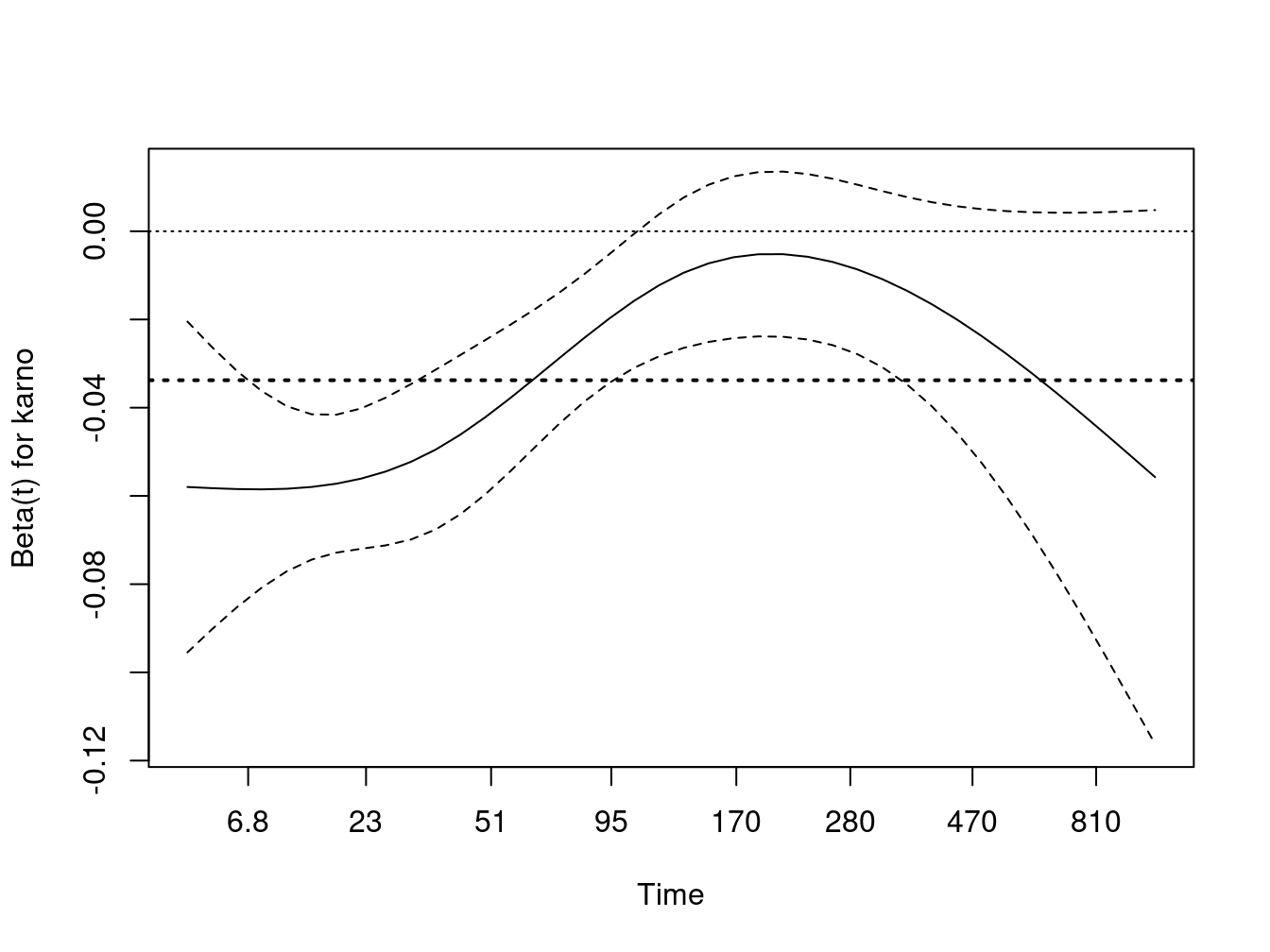
Karnofsky score is a very important predictor, but its effect is not constant over time as shown by both the test and the plot. Early on it has a large negative effect: the risk for someone at the first quartile is approximately exp(35*.05) = 5.7 fold times that of someone at the third quartile, but by 200 days this has waned and is not much different from one. One explanation is that, in this very acute illness, any measure that is over 6 months old is no longer relevant. Another is that a large portion of subjects with the lowest Karnofsky values have been lost; at 200 days 4% of the remaining subjects had a initial value \(\le 40\) versus 28% at the start.
The proportional hazards model estimates an average hazard over time, the value of which is shown by the dotted horizontal line. The use of an average hazard is often reasonable, the proportional hazards assumption is after all never precisely true. In this case, however, the departure is quite large and a time dependent coefficient is a more useful summary of the actual state. The cox.zph plot is excellent for diagnosis but does not, however, produce a formal fit of \(\beta(t)\). What if we want to fit the model?
4.1 Step functions
One of the simplest extensions is a step function for \(\beta(t)\), i.e., different coefficients over different time intervals. An easy way to do this is to use the survSplit function to break the dataset into time-dependent parts. We will arbitrarily divide the veteran’s data into 3 epochs of the first 3 months, 3-6 months, and greater than 6 months.
vet2 <- survSplit(Surv(time, status) ~ ., data= veteran, cut=c(90, 180),
                  episode= "tgroup", id="id")
vet2[1:7, c("id", "tstart", "time", "status", "tgroup", "age", "karno")]
#>   id tstart time status tgroup age karno
#> 1  1      0   72      1      1  69    60
#> 2  2      0   90      0      1  64    70
#> 3  2     90  180      0      2  64    70
#> 4  2    180  411      1      3  64    70
#> 5  3      0   90      0      1  38    60
#> 6  3     90  180      0      2  38    60
#> 7  3    180  228      1      3  38    60
The first subject died at 72 days, his data is unchanged. The second and third subjects contribute time to each of the three intervals.
vfit2 <- coxph(Surv(tstart, time, status) ~ trt + prior +
                  karno:strata(tgroup), data=vet2)
vfit2
#> Call:
#> coxph(formula = Surv(tstart, time, status) ~ trt + prior + karno:strata(tgroup),
#>     data = vet2)
#>
#>                                   coef exp(coef)  se(coef)      z
#> trt                          -0.011025  0.989035  0.189062 -0.058
#> prior                        -0.006107  0.993912  0.020355 -0.300
#> karno:strata(tgroup)tgroup=1 -0.048755  0.952414  0.006222 -7.836
#> karno:strata(tgroup)tgroup=2  0.008050  1.008083  0.012823  0.628
#> karno:strata(tgroup)tgroup=3 -0.008349  0.991686  0.014620 -0.571
#>                                     p
#> trt                             0.953
#> prior                           0.764
#> karno:strata(tgroup)tgroup=1 4.64e-15
#> karno:strata(tgroup)tgroup=2    0.530
#> karno:strata(tgroup)tgroup=3    0.568
#>
#> Likelihood ratio test=63.04  on 5 df, p=2.857e-12
#> n= 225, number of events= 128
cox.zph(vfit2)
#>                      chisq df     p
#> trt                   1.72  1 0.189
#> prior                 3.81  1 0.051
#> karno:strata(tgroup)  3.04  3 0.385
#> GLOBAL                8.03  5 0.154
A fit to the revised data shows that the effect of baseline Karnofsky score is essentially limited to the first two months. The cox.zph function shows no further time-dependent effect of Karnofsky score. This last is of course no surprise, since we used the original graph to pick the cut points. A “test” that the coefficients for the three intervals are different will be biased by this sequential process and should be viewed with caution.
Survival curves post fit require a little more care. The default curve uses the mean covariate values, which is always problematic and completely useless in this case. Look at the set of saved means for the model:
vfit2$means
#>                          trt                        prior
#>                     1.471111                     2.977778
#> karno:strata(tgroup)tgroup=1 karno:strata(tgroup)tgroup=2
#>                    35.662222                    19.022222
#> karno:strata(tgroup)tgroup=3
#>                     8.444444
The default curve will be for someone on treatment arm 1.47 % which applies to no one, and a single set of “blended” values of the Karnofsky score, each times the three Karnofsky coefficients. This is rectified by creating a new dataset with time intervals. We create two hypothetical subjects labeled as “curve 1” and “curve 2”. One has a Karnofsky of 40 and the other a Karnofsky of 75, both on treatment 1 and with no prior therapy. Each has the appropriate values for the time-dependent covariate tgroup, which is 1, 2, 3 over 0–90, 90–180 and 180+ days, respectively. We will draw curves for the first year.
quantile(veteran$karno)
#>   0%  25%  50%  75% 100%
#>   10   40   60   75   99
cdata <- data.frame(tstart= rep(c(0,90,180), 2),
                    time =  rep(c(90,180, 365), 2),
                    status= rep(0,6),   #necessary, but ignored
                    tgroup= rep(1:3, 2),
                    trt  =  rep(1,6),
                    prior=  rep(0,6),
                    karno=  rep(c(40, 75), each=3),
                    curve=  rep(1:2, each=3))
cdata
#>   tstart time status tgroup trt prior karno curve
#> 1      0   90      0      1   1     0    40     1
#> 2     90  180      0      2   1     0    40     1
#> 3    180  365      0      3   1     0    40     1
#> 4      0   90      0      1   1     0    75     2
#> 5     90  180      0      2   1     0    75     2
#> 6    180  365      0      3   1     0    75     2
sfit <- survfit(vfit2, newdata=cdata, id=curve)
km <- survfit(Surv(time, status) ~ I(karno>60), veteran)
plot(km, xmax= 365, col=1:2, lwd=2,
     xlab="Days from enrollment", ylab="Survival")
lines(sfit, col=1:2, lty=2, lwd=2)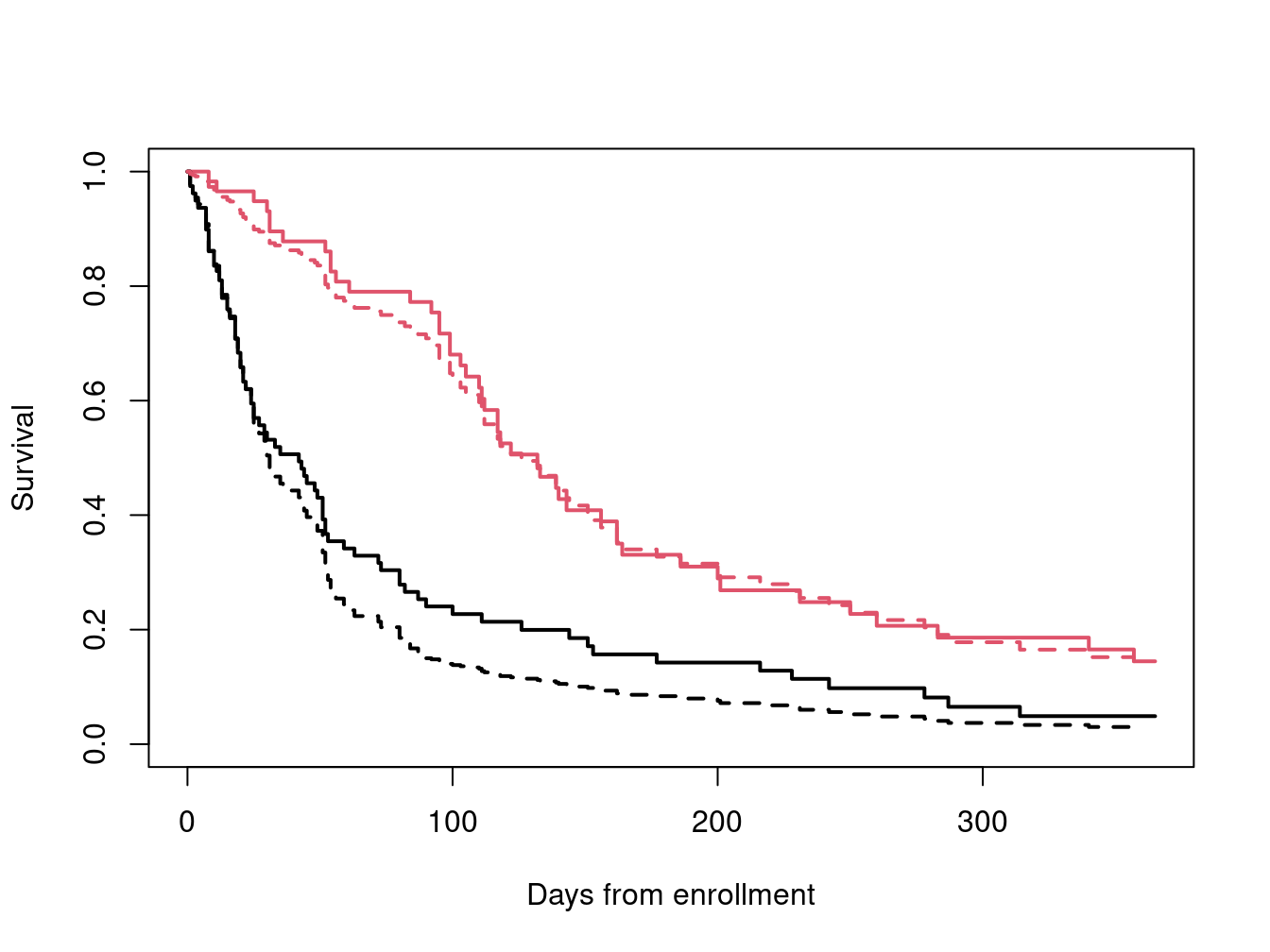
The default behavior for survival curves based on a coxph model is to create one curve for each line in the input data; the id option causes it to use a set of lines for each curve. Karnofsky scores at the 25th and 75th percentiles roughly represent the average score for the lower half of the subjects and that for the upper half, respectively, and are plotted over the top of the Kaplan-Meier curves for those below and above the median.
4.2 Continuous time-dependent coefficients
If \(\beta(t)\) is assumed to have a simple functional form we can fool an ordinary Cox model program in to doing the fit. The particular form \(\beta(t) =
a + b\log(t)\) has for instance often been assumed. Then \(\beta(t) x = ax + b
\log(t) x = ax + b z\) for the special time dependent covariate \(z = \log(t) x\). The time scale for the cox.zph plot used further above of \(\log(t + 20)\) was chosen to make the first 200 days of the plot roughly linear. Per the figure this simple linear model does not fit over the entire range, but we will forge ahead and use it as an example anyway. (After all, most users who fit the log(t) form, based on seeing it a paper, don’t bother to even look at a plot.) An obvious but incorrect approach is
vfit3 <- coxph(Surv(time, status) ~ trt + prior + karno +
                I(karno * log(time + 20)), data=veteran)
This mistake has been made often enough the the coxph routine has been updated to print an error message for such attempts. The issue is that the above code does not actually create a time dependent covariate, the principle reason being that the program cannot read your mind. There are two different times: the fixed value time in the data set, which contains the duration to death or follow-up for each subject, and the continuous variable \(t\) that appears in the mathematical equations as \(X(t)\), \(N(t)\), etc. As a user you were thinking of fixed duration on the left and \(t\) on the right.
The code above assumes the fixed value for both, and creates a time-static value for each subject based on their value for the covariate time; no differently than if we had constructed the variable outside of the coxph call and used log(zed) in the equation. This variable most definitely breaks the rule about not looking into the future, and if we fit the model one would quickly find the circularity: large values of time appear to predict long survival, because long survival leads to large values for time.
This same coding dichotomy exists in SAS phreg, by the way. Adding time to the right hand side of the model statement will create the time-fixed (incorrect) variable, while a programming statement within phreg that uses time as a variable will generate time-dependent objects. The error is less likely there because phreg’s model statement is less flexible than R, i.e., you cannot simply write “log(time)” on the right hand side of a formula for instance.
To deal with this we have four approaches. The first, but unwise idea might be to use tmerge to break the data set into a zillion small intervals, approximating continuous time. However, recognize that the underlying Cox likelihood will only be evaluated at the observed event times, thus it is sufficient to split at those times:
vdeath <- sort(unique(veteran$time[veteran$status==1]))
length(vdeath)
#> [1] 97
vet3 <- survSplit(Surv(time, status) ~ ., data= veteran, cut=vdeath,
                  episode= "tgroup", id="id")
quantile(table(vet3$id))
#>   0%  25%  50%  75% 100%
#>    1   19   43   66   97
The 97 cutpoints lead to 98 unique time intervals, and not surprisingly an average subject appears in about half of them. To avoid the warning from coxph we create a second copy of the time variable, since the warning will be spurious in this case.
vet3$xtime <- vet3$time
vfit3 <- coxph(Surv(tstart, time, status) ~ trt + prior + karno +
                   I(karno * log(xtime+20)), vet3)
plot(zp[3])
abline(coef(vfit3)[3:4], col=2, lty=2)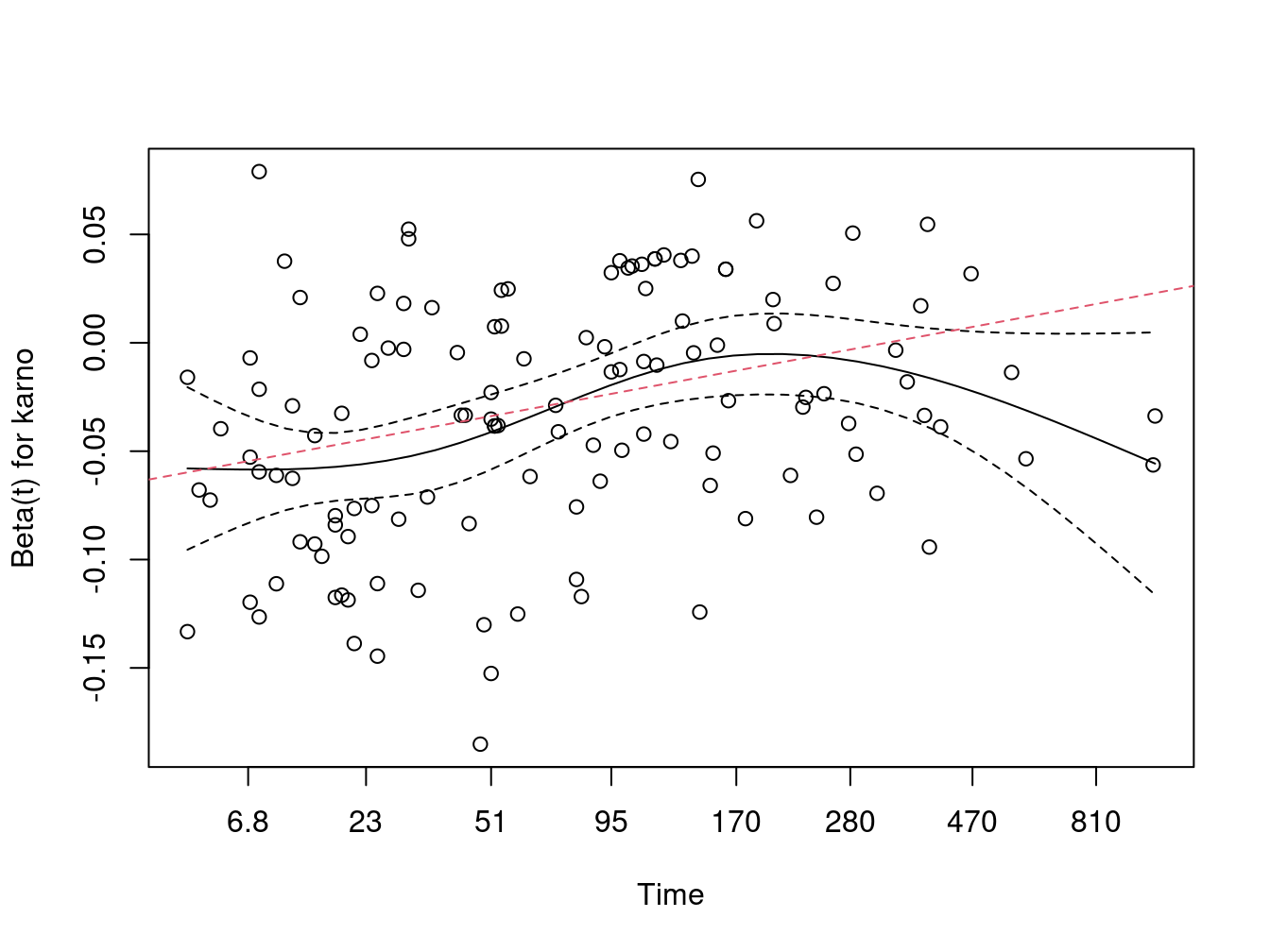
The time dependent coefficient is estimated to be \(\beta(t) =\) -0.125 + 0.021 * log(t + 20). We can add said line to the cox.zph plot. Not surprisingly, the result is rather too high for time \(>\) 300 and underestimates the steeper part of the slope. Still the fit is better than a horizontal line, i.e., a proportional hazards assumption, as confirmed by the p-value for the slope term in vfit3. (The p-value from cox.zph for karno is nearly identical, as it must be, since the tests in cox.zph are for a linear effect on the chosen time scale.)
The above can be done automatically by using the time-transform functionality of coxph.
vfit3b <-  coxph(Surv(time, status) ~ trt + prior + karno + tt(karno),
                data=veteran,
                tt = function(x, t, ...) x * log(t+20))
rbind(coef(vfit3b), coef(vfit3))
#>             trt        prior      karno  tt(karno)
#> [1,] 0.01647766 -0.009317362 -0.1246623 0.02130957
#> [2,] 0.01647766 -0.009317362 -0.1246623 0.02130957
Realize that it is not necessary to use all 97 cut points: 50 or even 25 will be more than sufficient to get an accurate approximation. This is particularly important with large data sets, there are for instance 13081 unique days with a test result and 17549 subjects, leading to a potential expanded data set of over 100 million observations. Think first and use a rational grid of cutpoints for survSplit.
We no longer recommend the use of the tt functionality for this reason, it always does the full expansion. Another reason is that the resulting fit is a dead end: the expanded data set created internally to coxph is not available after the fit, so residuals and predicted values are not available — they would be residuals for exactly what observations?
As compared to fitting a single term that is linear in a predetermined function of time, i.e., the test for PH done by cox.zph, a more general approach is to allow a flexible fit on the right hand side, mimicking the approximate plot performed by plot.cox.zph. This is shown in the following.
ns2 <- function(x) ns(x, knots=c(100, 200), Boundary.knots = c(5,400))
vfit4 <-  coxph(Surv(tstart,time, status) ~ trt + prior + karno +
                    karno:ns2(xtime), data=vet3)
vfit4
#> Call:
#> coxph(formula = Surv(tstart, time, status) ~ trt + prior + karno +
#>     karno:ns2(xtime), data = vet3)
#>
#>                        coef exp(coef)  se(coef)      z        p
#> trt               -0.025937  0.974397  0.191034 -0.136 0.892003
#> prior             -0.005787  0.994229  0.020299 -0.285 0.775556
#> karno             -0.059583  0.942157  0.009414 -6.329 2.46e-10
#> karno:ns2(xtime)1  0.048183  1.049363  0.027107  1.778 0.075480
#> karno:ns2(xtime)2  0.100300  1.105503  0.028349  3.538 0.000403
#> karno:ns2(xtime)3  0.011549  1.011616  0.020757  0.556 0.577929
#>
#> Likelihood ratio test=59.02  on 6 df, p=7.111e-11
#> n= 5959, number of events= 128

# termplot does not create sensible estimates for interactions (per its
#  help page), so do it by hand for the karno term
smat <- cbind(1, ns2(5:400)) # a range of plotting values
estimate <- drop(smat %*% coef(vfit4)[3:6])
sd.est <- sqrt(diag(smat %*% vcov(vfit4)[3:6, 3:6] %*% t(smat)))
yy <- estimate + outer(sd.est, c(0, -1.96, 1.96), "*")
matplot(5:400/30.5, yy, type='l', lty=c(1,2,2), col=1, lwd=c(2,1,1),
        xlab="Months", ylab= "Estimated beta(t) for karno")
abline(0,0, lty=3)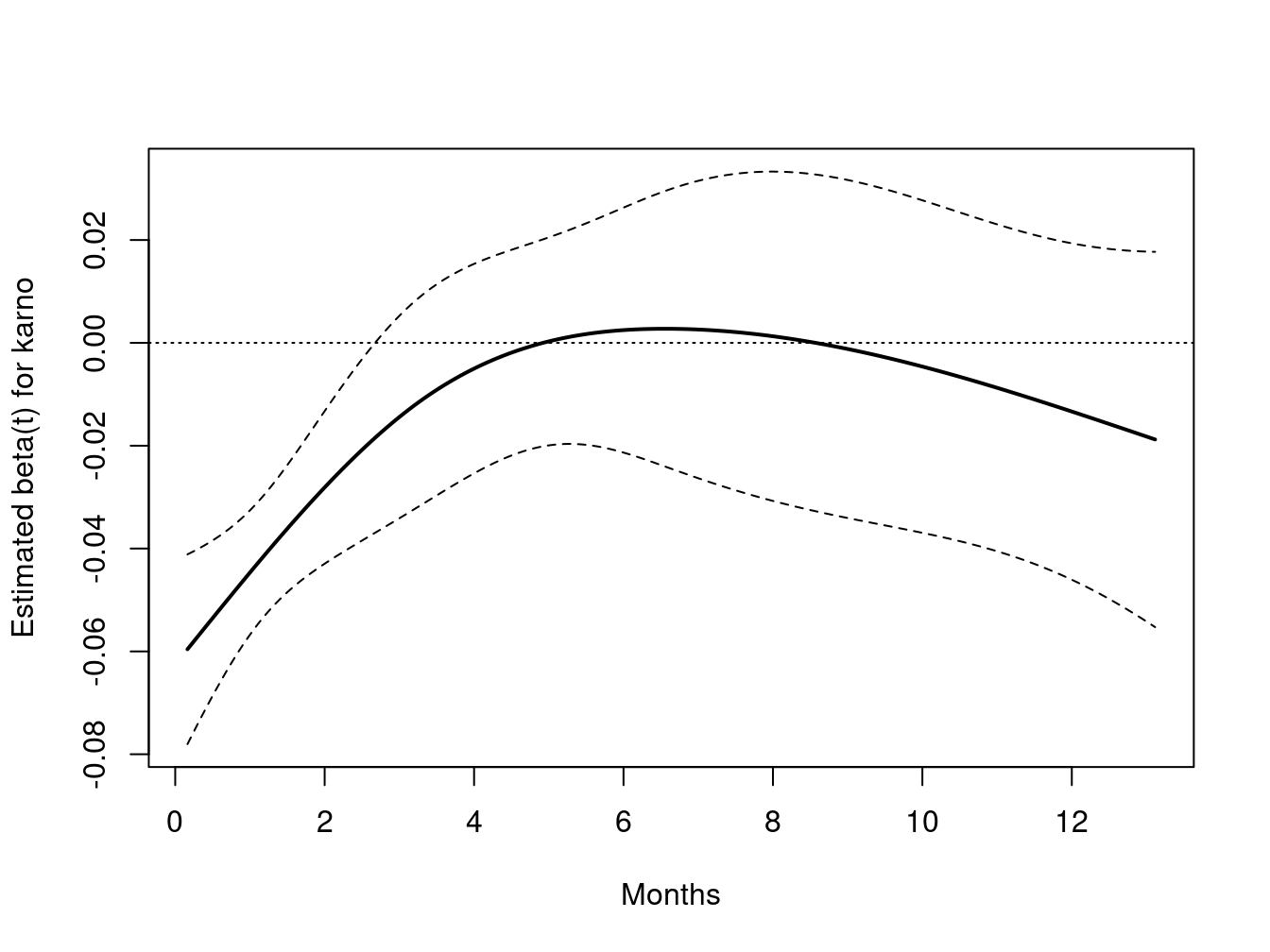
We see a large decrease in effect over the first 5 months, to near zero; with very wide CI for any changes thereafter.
The use of programming statements to create a yes/no variable deserves extra comment because of a common error. Assume one has a data set with two time variables: the time from enrollment to last follow up and the time to diabetes, say, and we want to use the presence of diabetes as time dependent covariate. Here is a small made up example.
data1 <- read.table(col.names=c("id", "diabetes", "lfu", "status"),
                          header=FALSE, text="
1   5 30  1
2  10 15  1
3  NA 60  0
4  NA 80  1
5  10 80  0
6  NA 90  1
7  30 95  1
")

data1$d2 <- pmin(data1$diabetes, 300, na.rm=TRUE) #replace NA with 300
fit1 <- coxph(Surv(lfu, status) ~ tt(d2), data=data1,
              tt = function(d2, t, ...) ifelse(t > d2, 1, 0))
fit2 <- coxph(Surv(lfu, status) ~ tt(d2), data=data1,
              tt = function(d2, t, ...) ifelse(t < d2, 0, 1))
c(coef(fit1), coef(fit2))
#>     tt(d2)     tt(d2)
#> 0.24395607 0.07173475
One might have expected fit1 and fit2 to give the same coefficient but they are completely different. The issue is subject 7 whose time to diabetes falls exactly at one of the event times. In fit1 their diabetes covariate effectively changes just after the event at time 30, in fit2 it changes at the event. The second is incorrect. Stated in the gambling context, all roulette bets must be placed before the ball lands in the slot, or they apply to the next spin of the wheel.
Likewise, a change in diabetes status needs to apply to the next event time.
When a data set is expanded into a start, stop format using the tmerge function ties are dealt with correctly.
data2 <- tmerge(data1, data1, id=id, dstat=event(lfu, status),
                diab = tdc(diabetes))
subset(data2, id %in% c(1,7), c(id, tstart:diab))
#>    id tstart tstop dstat diab
#> 1   1      0     5     0    0
#> 2   1      5    30     1    1
#> 10  7      0    30     0    0
#> 11  7     30    95     1    1
fit3 <- coxph(Surv(tstart, tstop, dstat) ~ diab, data2)
c(coef(fit1), coef(fit2), coef(fit3))
#>     tt(d2)     tt(d2)       diab
#> 0.24395607 0.07173475 0.24395607
5 Predictable time-dependent covariates
Occasionally one has a time-dependent covariate whose values in the future are predictable. The most obvious of these is patient age, occasionally this may also be true for the cumulative dose of a drug; say that subjects are assigned to take one 5mg tablet a day (and they keep their schedule). If age is entered as a linear term in the model, then the effect of changing age can be ignored in a Cox model, due to the structure of the partial likelihood. Assume that subject \(i\) has an event at time \(t_i\), with other subject \(j \in R_i\) at risk at that time, with \(a\) denoting age. The partial likelihood term is \[\begin{equation*} \frac{e^{\beta * a_i}}{\sum_{j \in R_i} e^{\beta* a_j}} = \frac{e^{\beta * (a_i + t_i)}}{\sum_{j \in R_i} e^{\beta* (a_j + t_i)}} \end{equation*}\] We see that using current age (the right hand version) or age at baseline (left hand), the partial likelihood term is identical since \(\exp(\beta t_i)\) cancels out of the fraction. However, if the effect of age on risk is non-linear, this cancellation does not occur.
Since age changes continuously, we would in theory need a very large data set to completely capture the effect, one interval per day to match the usual resolution for death times. In practice this level of resolution is not necessary; though we all grow older, risk does not increase so rapidly that we need to know our age to the day. As an example, below we fit twice, once divided at every death time, and once with an update per year.
dtimes <- sort(unique(with(pbc, time[status==2])))
tdata1 <- survSplit(Surv(time, status==2) ~., pbc, cut=dtimes)
tdata1$c.age <- tdata1$age + tdata1$time/365.25 -50 #current age, centered at 50
pfit1 <- coxph(Surv(tstart, time, event) ~ log(bili) + ascites + c.age +
    I(c.age^2) + I(c.age^3), data=tdata1)

tdata2 <- survSplit(Surv(time, status==2) ~., pbc, cut=1:12 * 365.25)
tdata2$c.age <- tdata2$age + tdata2$time/365.25 -50 #current age, centered at 50
pfit2 <- coxph(Surv(tstart, time, event) ~ log(bili) + ascites + c.age +
    I(c.age^2) + I(c.age^3), data=tdata2)

rbind(coef(pfit1), coef(pfit2))
#>      log(bili)  ascites      c.age   I(c.age^2)    I(c.age^3)
#> [1,]  1.048684 1.290612 0.06659921 0.0003039680 -9.170991e-05
#> [2,]  1.048597 1.326572 0.06250674 0.0005213566 -9.722513e-05
c(nrow(pbc), nrow(tdata1), nrow(tdata2))
#> [1]   418 42401  2402
We have almost the same result but at 1/20th the data set size.
This can make a substantial difference in compute time for large data sets. Exactly how much to thin down' the list of cutpoints can be based on subject specific knowledge, one could choose selected points based on acox.zph` plot, or start with a very coarse time grid and then sequentially refine it. In this data set we reasoned that although risk increases with age, a age change of less than one year would have minimal impact.
For the veteran data set 131/137 of the observation times are at 13 months or less. Look at cutting this into 14 different points:the interval starting at 0, at 1 month, at 2 months, \(\ldots\), 13 for construction of the time-dependent Karnofsy coefficient. This does not categorize the follow-up times themselves, only the time-dependent effect, so we don’t lose precision in the response.
dtime <- round(1:13 * 30.5)
vdata2 <- survSplit(Surv(time, status) ~ ., veteran, cut=dtime,
                    episode= "month")
vfit1 <- coxph(Surv(tstart, time, status) ~ trt + prior + karno, vdata2)
vfit5 <- coxph(Surv(tstart, time, status) ~ trt + prior + karno +
                   karno:ns(month, df=3), vdata2)
anova(vfit1, vfit5)
#> Analysis of Deviance Table
#>  Cox model: response is  Surv(tstart, time, status)
#>  Model 1: ~ trt + prior + karno
#>  Model 2: ~ trt + prior + karno + karno:ns(month, df = 3)
#>    loglik  Chisq Df Pr(>|Chi|)
#> 1 -483.93
#> 2 -476.06 15.745  3   0.001279

tdata <- expand.grid(trt=0, prior=0, karno=30, month=seq(1,13, length=50))
yhat <- predict(vfit5, newdata=tdata, se.fit=TRUE, reference="zero")
yy <- yhat$fit+ outer(yhat$se.fit, c(0, -1.96, 1.96), '*')
matplot(seq(1,13, length=50), yy, type='l', lty=c(1,2,2), col=1, lwd=c(2,1,1),
        xlab="Month of fu", ylab="Effect, Karnofsky 60 vs 90")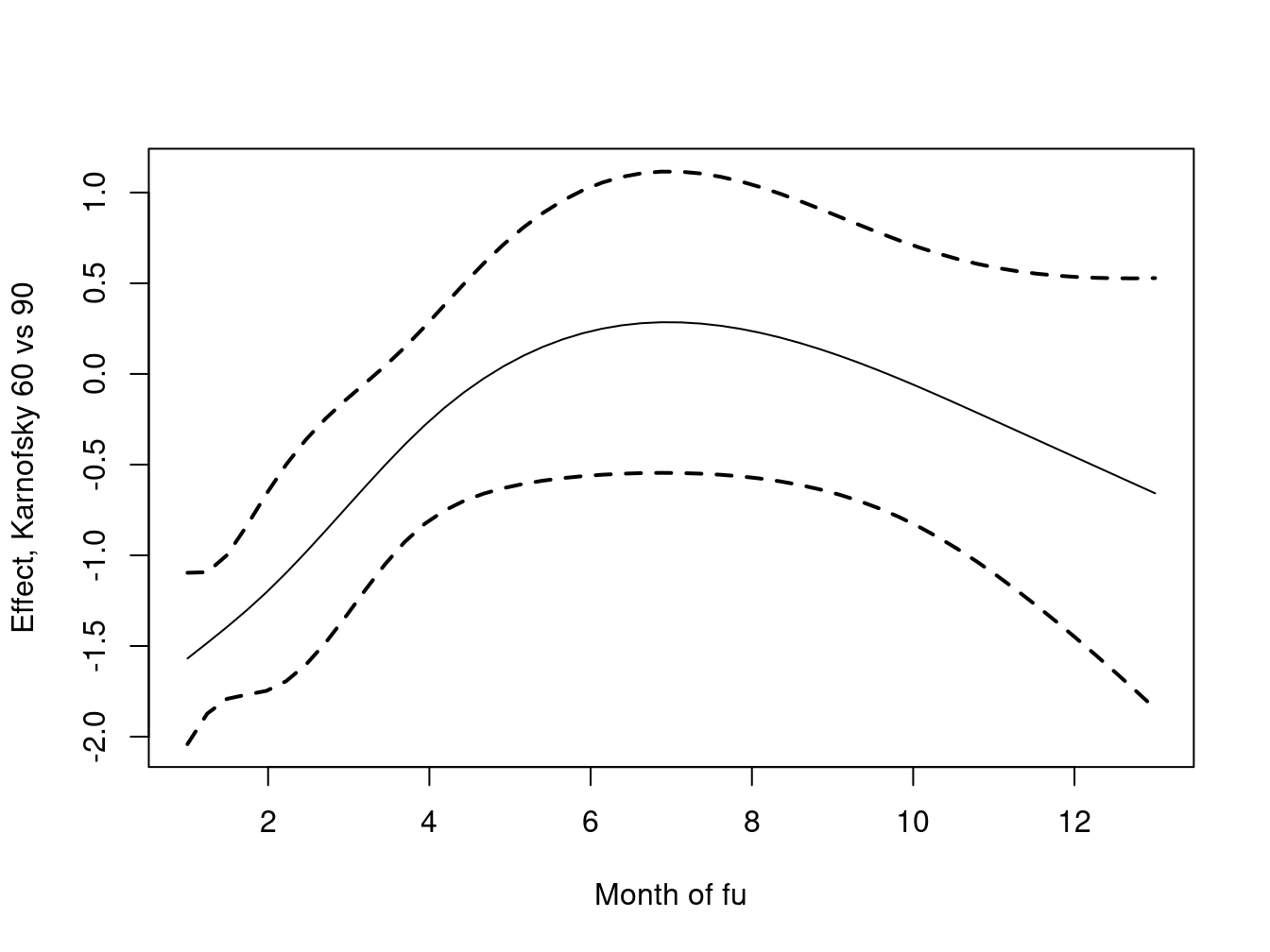
Because the spline is now a direct part of the model downstream functions such as anova work properly, and it is straightforward to create a plot of the of the fit. A Cox model produces relative risk, and the default for the predict function is to use the mean covariates as our reference. We wanted to assess the effect of a 30 point change in Karnofsy, holding the other covariates fixed: values of 0 plus a reference of 0 accomplished this.
For these small data sets the tt() approach and a subset of times are both feasible, but for a large data set the first can become very slow, or even run out of resources. The reason is that a a Cox model fit requires computation of a weighted mean and variance of the covariates at each event time, a process that is inherently \(O(ndp^2)\) where \(n\) = the sample size, \(d\) = the number of events and \(p\)= the number of covariates.
Much of the algorithmic effort in the underlying code is to use clever updating methods for the mean and variance matrices, reducing the compute time to \(O(np + d p^2)\). For a large data set the tt() approach can produce an intermediate data set with \(O(nd)\) rows, however, overcoming the computation. For even moderate data sets the impact of \((nd)p\) vs \(np\) can be surprising.
There are other interesting uses for the time-transform capability. One example is O’Brien’s logit-rank test procedure (1978). He proposed replacing the covariate at each event time with a logit transform of its ranks.
This removes the influence of any outliers in the predictor \(x\). For this case we ignore the event time argument and concentrate on the groupings to create the following tt function.
function(x, t, riskset, weights){
    obrien <- function(x) {
        r <- rank(x)
        (r-.5)/(.5+length(r)-r)
    }
    unlist(tapply(x, riskset, obrien))
}
This relies on the fact that the input arguments to tt() are ordered by the event number or risk set. This function is used as a default if no tt argument is present in the coxph call, but there are tt terms in the model formula. (Doing so allowed me to depreciate the survobrien function).
Another interesting usage is to replace the data by simple ranks, not rescaled to 0–1.
function(x, t, riskset, weights)
    unlist(tapply(x, riskset, rank))
The score statistic for this model is \((C-D)/2\), where \(C\) and \(D\) are the number of concordant and discordant pairs, see the concordance function.
The score statistic from this fit is then a test for significance of the concordance statistic, and is in fact the basis for an approximate standard error for the concordance. The O’Brien test can be viewed as concordance statistic that gives equal %’ weight to each event time, whereas the standard concordance weights each event proportionally to the size of the risk set.
6 References
Anderson, J. R., K. C. Cain, and R. D. Gelber. 1983. “Analysis of Survival by Tumor Response.” J Clinical Oncology 1: 710–19.
Berkson, J., and R. Gage. 1950. “Calculation of Survival Rates for Cancer.” Proc of the Staff Meetings of the Mayo Clinic 25: 270ff.
Bonadonna, G., and P. Valagussa. 1981. “Dose-Response Effect of Adjuvant Chemotherapy in Breast Cancer.” New England J. Medicine 34: 10–15.
Buyse, M., and P. Piedbois. 1996. “The Relationship Between Response to Treatment and Survival Time.” Stat. In Medicine 15: 2797–2812.
Crowley, J., and M. Hu. 1977. “Covariance Analysis of Heart Transplant Survival Data.” J. Amer. Stat. Assoc. 72: 27–36.
Kalbfleisch, J. D., and R. L. Prentice. 2002. The Statistical Analysis of Failure Time Data, Second Edition. Wiley.
O’Brien, Peter C. 1978. “A Nonparmetric Test for Association with Censored Data.” Biometrics 34 (2): 243–50.
Redmond, C., B. Fisher, and H. S. Wieand. 1983. “The Methodologic Dilemma in Retrospectively Correlating the Amount of Chemotherapy Received in Adjuvant Therapy Protocols with Disease Free Survival: A Commentary.” Cancer Treatment Reports 67: 519–26.
Suissa, S. 2008. “Immortal Time Bias in Pharmacoepidemiology.” American J Epidemiology 167: 492–99.